Over the past two years, the Albanese government has increased the cost, evidentiary burden, and scrutiny of student visas to stem the flow of non-genuine students.
Measures introduced include:
- Tougher English-language requirements: From March 2024, the minimum English proficiency standard for student visas increased from an IELTS equivalent 5.5 to 6.0.
- Major increase in student visa fees: On 1 July 2024, the student visa application fee more than doubled from $710 to $1,600.
- Restrictions on “visa hopping”: Closing pathways that allowed temporary visa holders to repeatedly extend their stay through student visas and tightening eligibility for onshore student visa applications, including requiring students applying for another student visa to demonstrate genuine academic progression.
- Increased scrutiny of high-risk countries and providers: The Department of Home Affairs received additional funding to strengthen visa integrity checks and identify non-genuine students.
- Banning most student visa holders from bringing spouses and children as secondary applicants.
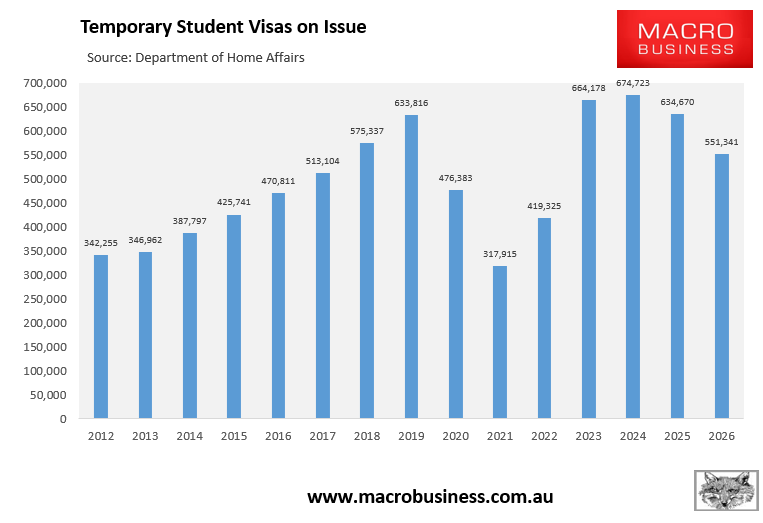
The measures have proven successful, with overall student visa numbers falling to around 551,300 in the September quarter of 2026, down from a peak of 674,700 in the September quarter of 2024:
Refusal rates have also risen sharply for applicants from several high-risk source countries, and visa applications and grants have declined significantly, particularly from South Asia and Africa.
As reported by Times Higher Education, offshore higher education visa applications in September were 43% lower than a year earlier, and higher education visa grants were down 42% over the same period.
Countries targeted by compliance and integrity measures, including India, Nepal, Bangladesh, Bhutan, Kenya, and Nigeria, have seen the steepest declines.
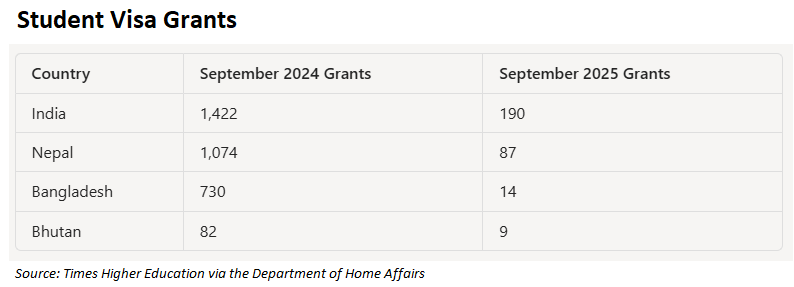
Rejection rates have risen from below 10% last year to:
- 83% for Nepal
- 78% for Bangladesh
- Nearly 80% for Kenya and Nigeria
China remains a special case, with Chinese student visa grant rates remaining above 90%. However, demand from China is also weakening, with higher education visa applications in September tracking 24% lower than a year earlier.
A win for visa integrity:
A 2022 Navitas survey gauging why international students choose to study in Australia cited “post-study work rights”, “opportunities to work while studying”, and “opportunities for permanent migration” as particularly important for students from South Asia.
Jobs & Skills Australia’s (JSA) International Students Pathways and Outcomes Study, released in August 2025, likewise provided clear evidence that international students increasingly view Australian student visas as a pathway to long‑term residency and that quality and integrity problems in the current system are undermining both student outcomes and Australia’s skills strategy.
JSA explicitly noted that “nearly 70% of international higher education students reported that the possibility to migrate was a reason for choosing to study in Australia, rising to 77% of Indian and 79% of Nepali higher education students”.
Furthermore, JSA reported that over 90% of Indian and nearly 96% of Nepali higher-education students chose Australia for the opportunity to work while studying. “80% of students from South and Central Asia (including India and Nepal) were working during study”.
JSA found that students increasingly chose courses, providers, and locations based on perceived pathways to permanent residency rather than educational value.
“For many students, migration aspirations are a primary goal”, JSA said. “The purpose underlying the choices of many students was to seek permanent residence in Australia”.
“Graduates’ persistence means they have become an important feeder group to Australia’s permanent migration program. Many international students have moved from one temporary visa to another, extending their time in Australia along the way. Some have pursued a pathway that tracks a course to permanent residency”.
The Albanese government’s tightening of the student visa system has clearly stemmed the flow of non-genuine students seeking work and permanent residency.